Author: Ragnhild Myren Stephansen, Head of Legal | Nomadexus AS
The Schengen Entry/Exit System (EES) represents one of the most significant modernizations of European border management in decades. For many employers operating in Norway—particularly those in offshore, oil and gas, maritime and project‑based sectors—the system will affect how non‑EU employees enter and exit the country and how companies should plan their travel logistics. Although EES has been discussed for several years, many travelers still encounter it for the first time at the airport, unaware of why they suddenly must provide fingerprints and a facial photograph at the border.
This blog provides a clear and updated explanation of what the system is, how it works in practice in Norway, what it means for third‑country nationals, and how offshore rules differ between fixed and mobile installations. The blog also incorporates insight received from Norwegian police authorities regarding the implementation at Stavanger Airport, one of Norway’s busiest entry points for offshore workers.
What is the EES—and why does it matter?
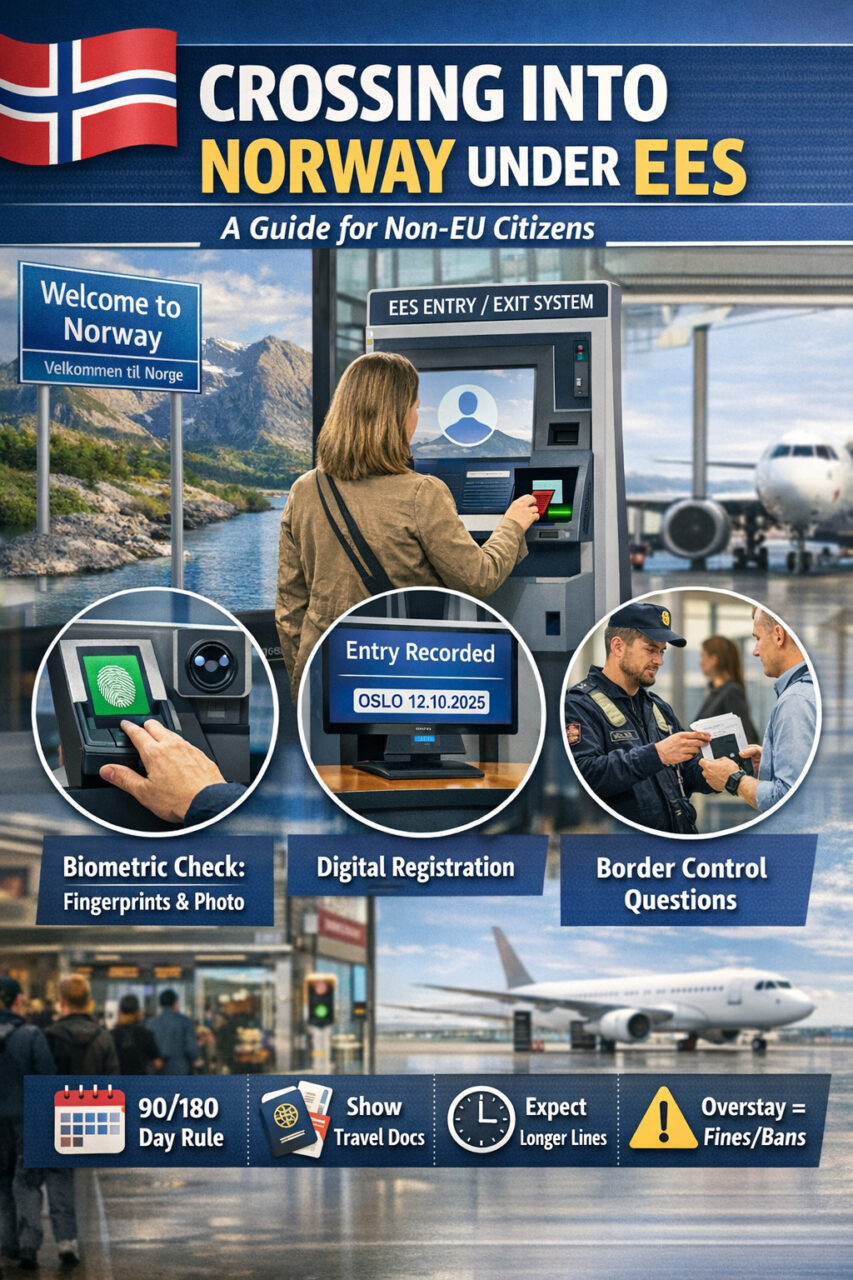
The Entry/Exit System (EES) is a new Schengen border control system for non‑EU/EEA travelers coming to the Schengen area for short stays. The traveler’s identity, passport details and biometric information—fingerprints and a facial photograph—are registered electronically when they cross the border.
Once registered, the system automatically records the exact time and place of every entry and exit. This gives a far more accurate overview of a traveler’s movements and makes it easier to apply the Schengen short‑stay rule, which allows non‑EU/EEA citizens to stay in the Schengen area for up to 90 days within any 180‑day period.
EES implementation in Norway
Norway began using the EES on 12 October 2025 at Oslo Airport Gardermoen. The rollout has since been gradual, with different police districts introducing the system at different times. Stavanger Airport, a critical hub for offshore personnel traffic, introduced EES on 11 November 2025
Implementation across the Schengen area is ongoing, which means various countries are still transitioning from the old passport stamping routine to the digital EES registration. As more countries deploy the system, its practical impact will become increasingly visible through 2026.
Who must be registered – and who is exempt?
EES applies to all third‑country nationals entering the Schengen area for short stays. This includes citizens of visa‑exempt countries such as the United Kingdom, the United States, Canada and Australia, as well as nationals who require a visa.
Travelers not registered include:
- EU/EEA citizens, including Norwegian nationals
- Third‑country nationals who hold a valid residence permit or residence card from a Schengen country
- Specific narrowly defined exempt categories
How registration works at the border
On the first entry into a border crossing point that has implemented EES, the traveler will undergo a full registration process. Border control will create an EES profile, take a facial photograph and collect fingerprints. Biometric registration is mandatory, and entry must be refused if the traveler declines to provide the required information.
On subsequent trips, travelers do not need to give biometrics again, but their identity will be verified against the data already stored in the system. Each entry and exit is then logged automatically, creating a reliable digital record of travel within Schengen.
Despite these new digital requirements, the police underline that current operational routines remain unchanged. Travelers must still present themselves physically for border control, just as before.
The introduction of EES changes how information is registered — not where or when travelers must appear. Border control therefore continues to operate through the same checkpoints and with the same expectations of physical presence, even though registration is now biometric and electronic.
Expected processing times
The introduction of biometric registration inevitably increases processing times.
According to police feedback, for third‑country nationals, the control process can take two to three times longer than before—particularly during first‑time registration.
This is relevant for employers who manage high‑volume crew changes or rely on frequent rotation schedules.
Offshore and maritime sector: Fixed vs. Mobile installations
For employers operating in Norway’s offshore and maritime industry, EES interacts with an already complex set of rules regarding immigration, residence permits and notification obligations.
Fixed installations
For work on fixed installations, third‑country nationals generally must hold a Norwegian residence permit. Where such a permit exists, the worker is not registered in EES when travelling between the fixed installation and the mainland, as these movements are not considered Schengen entry or exit events.
There is, however, a narrow exception for certain technical specialists who may be exempt from the residence permit requirement. The employer must submit a notification to the police upon the worker’s entry into Norway. These individuals are fully subject to border control and must be registered in EES upon arrival in Norway.
Mobile (movable/floating) installations
The rules differ significantly for mobile installations. Third‑country nationals working on these installations do not need a Norwegian residence permit, but the employer must submit a notification to the police upon the worker’s entry into Norway.
Visa‑required nationals must still hold a valid Schengen visa.
Persons who do not need a visa to visit Norway (visa-free)
These workers are always registered in EES upon arrival, and on later rotations between the mainland and the installation their entry and exit are recorded every time. Border control procedures remain unchanged in terms of where and how attendance takes place.
Your rights to data access and correction
Any traveler who is registered in the EES has the right to access the personal data stored about them, as well as the right to request correction of inaccurate or incomplete information. In certain circumstances, they may also request deletion of data or a limitation on how the data is processed, and they may lodge a complaint if they believe their information has been mishandled.
In Norway, Eastern Police District (Øst politidistrikt) is the authority responsible for handling these matters. Travelers who wish to request access, correction or deletion can use the official form provided by the police.
Eastern Police District details
Insights from the Norwegian police
To provide an updated and practical perspective, Nomadexus contacted the police regarding implementation and experiences at Stavanger Airport. They report that the system has been stable, with minimal downtime and generally smooth operations. The most notable effect has been the increased processing time for third‑country nationals, consistent with the expected biometric requirements.
The police have introduced queue‑reducing measures, including additional staffing financed by Avinor, to facilitate smoother flows through border control. They emphasise that good preparation is essential, and that both employers and travelers can help minimise delays by ensuring:
- having passports ready,
- having relevant permits ready,
- having relevant visas ready,
- understanding which documents may be required to verify the purpose of travel, and
- being aware of the biometric procedures (fingerprints and facial photograph
According to the police, travellers who arrive well prepared move through the border significantly faster, and clear communication from employers helps prevent queues from building up.
For offshore operations, the police confirmed the distinctions between fixed and mobile installations and reiterated that British citizens must be treated as third‑country nationals for EES purposes. They also pointed out a number of recurring misunderstandings among both employers and travelers. Common issues include uncertainty about who must be registered—the main rule being that all third‑country nationals on short stays must be registered in EES—and confusion about what biometric registration actually involves. In practice, both a facial photo and fingerprints are required, and cold, wet or worn hands may make fingerprint capture more challenging. There are also misunderstandings relating to the calculation of stay periods, where EES is intended to support better monitoring of the 90/180‑day rule.
The police further note that EES is being introduced gradually across the Schengen area, which means that some effects—such as the detection of overstays—will become more visible once more countries have implemented the system. In addition, the upcoming ETIAS regime will place further obligations on travelers before entering Schengen, adding another layer to pre‑travel compliance.
ETIAS
ETIAS (European Travel Information and Authorisation System) is a new digital pre‑travel authorisation that visa‑exempt travelers will need before entering the Schengen area. It is not a visa, but a simple online security check that must be completed prior to travel.
ETIAS is expected to become mandatory from late 2026 and will apply to citizens from countries that currently travel visa‑free to Schengen, such as the United Kingdom, the United States and Canada.
Once approved, the authorisation will be valid for multiple trips for up to three years.
How Nomadexus can help
Navigating Norway’s immigration rules can be complex—particularly when offshore operations, shift rotations and international mobility intersect. At Nomadexus, we support employers and employees throughout the entire process. We regularly assist with applications for residence permits for skilled workers, advise on mobility strategies for offshore personnel, and provide guidance on compliance issues linked to EES, visa requirements, and export control.
Nomadexus ensures that businesses understand their obligations, avoid unnecessary delays, and maintain compliance throughout the employment relationship.
You can contact us or book a consultation through our website: Get in touch
Other blog’s from Nomadexus:
Who needs a residence permit in Norway?
Residence permit for electricians from outside the EU/EEA